
Fig. 1 Statue of Erasmo Iacovone by Francesco Trani, built in 2002.
In football you come across many stories which leads us to the question ‘what if?’ Some of the major ‘what if’s’ have become destiny altering moments which have often been linked to tragedy. A good example of this is perhaps the Superga air disaster in 1949 which cost the lives of many great football players in a fantastic Torino team that appeared destined to achieve further greatness. Football history provides many of these unfortunate moments. The story of Taranto FC is also tinged with such a destiny altering story. A club story that has not only altered the identity of the club but also it’s fans. However, there is a long line of interesting stories, complications and triumphs that lead to the year where Taranto FC dared to dream that they could reach the heights of Italy’s top division Serie A. The 1977/1978 season in Serie B for Taranto proved to be the season that produced joy,hope, elation and heartbreak. This was largely due to one player in particular whose name was Erasmo Iacovone and he was the heart and soul of a team which has been commonly named Il Taranto Piu Bello. The most beautiful Taranto.
I have chosen to begin my journey with the club officially named Taranto FC 1927 more commonly know as Taranto. Taranto currently play their football in Serie C Group 3. I have chosen to start with this particular club because the city is home to much of my family and among all the other clubs I intend to complete my research, this is the club that is most familiar to me. That said, I believe that Taranto, like many clubs in Italy has a fascinating and overlooked story to tell. Particularly when analysing the club’s connection to its fans and the identity of the city and its inhabitants.
Fig. 2 Taranto’s current badge.
The image on Taranto’s badge is a dolphin swimming around Neptune’s fork. This is a reference to the ancient image of the boy Taras who was said to ride dolphins in the bay of Taranto within Greek mythology. It is also a reference to the city’s Greek heritage as it was founded as a Spartan colony, they named the city Taras who is said to be the son of Neptune. Hence, why many Tarantini refer to themselves as people of the sea. The city is also known as the city of two seas, as it is home to large expanses of water known as “Mar Grande” and “Mar Piccollo”.

Fig. 3 The Aragonese Castle and the famous suspension bridge that leads to Mar Grande.
Since the city’s ancient origins, it has always proven to be key port of a mercantile nature and ship building. So much so that once the Romans came to inhabit the area used the larger part of the port to construct ships. It was later called “La Arsenale” which means The Arsenal, a name that would later influence the name of Taranto football club itself so much so that in 1951 the city’s team became US Arsenal Taranto.
Along with city’s strong maritime trade links, and ship building industry, there is one particular industry the city and it’s people have become synonymous with for all the wrong reasons and that is metal industry. In 1965 the companies including Ilva, Finnsider and IRI merged and built one of the worlds largest iron and steel development complexes in Taranto under the name Italsider. Over the years the human cost of this has greatly outweighed the financial benefits of the plant, as the plant itself has been found to produce elevated emissions of dioxin which have in turn increased cancer cases to an alarming level. The plant until this day continues to provide jobs for the people of Taranto, however it continues to come at a huge cost. A cost not lost to the city’s club and it’s fans.
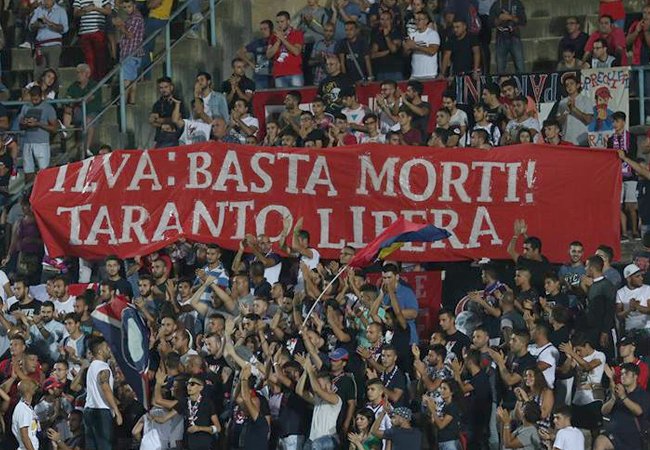
Fig. 4 Taranto fans protesting against ILVA.
Taranto until this day remains a city of contrasts. A beautiful coastal city with a dark ugly underbelly. It is out of this chaotic mix that a unique connection between a football club and it’s people has emerged.
A walk in the Salinella
On a hot summer’s day in the city of Taranto. There is one particular day among all which brings together the neighbourhood “il rione” or “Quartiere” like no other. It’s market day. The area the market takes place, is know as the Salinella neighbourhood. It is an area where you are surrounded by white tower blocks and balconies. It feels like the buildings themselves have come together to surround you specifically. Murals embellish the buildings with iconographic representations of the city itself.

Fig.5 Neptune Mural in Taranto. A representation of city’s identity and past.
The wide streets are buzzing with stalls, fake clothing, street food outlets, numerous old vehicles sounding their way through the crowds. There is also the smell of fresh mussels as a particular breed of mussel is farmed in the city and in itself has become symbolic of it’s people as they often reference themselves as “gente di mare” people of the sea.
Amongst the clamour and business of the Salinella neighbourhood one thing truly does stand out, and that is the songs of the market sellers. The songs of the market sellers are still the same today as they were when I was a child, and they sing the lyrics in the Tarantino dialect that translates to…
“Taranto Mia! Taranto Mia! Daje! Daje! Ama she verdere Iacovone”
“My Taranto! My Taranto! Hurry up! Hurry up! we are going to see Iacovone”
It was here that as a child I first heard the name Erasmo Iacovone whilst buying a Super Santos Ball to take to the beach. A ball now so emblematic of my period of childhood. Back In the present day, these footballs are still sold at the Salinella. As one looks through the market stalls and past blocks of apartments, one can see an even larger structure Lo Stadio Erasmo Iacovone.
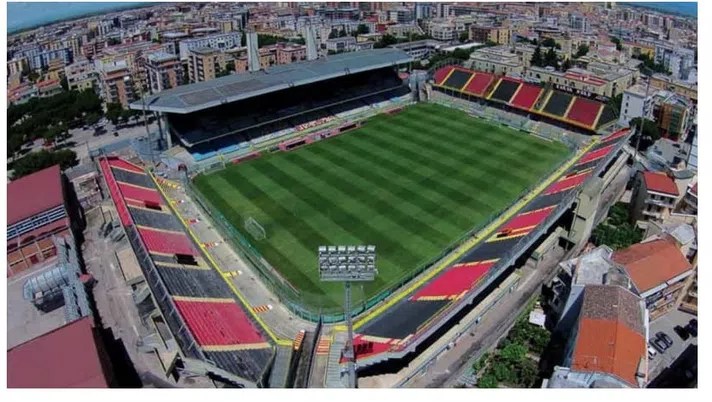
Fig.6 Stadio Erasmo Iacovone.
The current stadium named Lo Stadio Erasmo Iacovone currently holds a capacity of 27,584 making it one of the larger stadiums in the south of Italy. Placing this into context it has a bigger stadium than quite a few current Serie A clubs including Venezia, Cagliari, Empoli, and Monza to name a few. That said an important statistic shows that Taranto is the largest city in Italy to have a team that has never reached Serie A, Italy’s top division. I have often thought that the founders of Taranto as a football club had strong ambitions for the club and social issues surrounding the country’s North and South Divide has often contributed to the lack of success in the club. The truth is that it is a lot more complicated, and it is these complications that have formed the basis of the clubs identity, along with it’s shared identity with the city itself.
Club History
The first official team in Taranto was curiously named after the poet and supporter of the Italian Risorgimento Lucifero de Mario Rapisardi. The team was named simply named Mario Rapisardi and was established in 1904. Around the same time another team had emerged named US Pro Italia. The two teams attempted to merge and failed miserably due to political indifferences. The line of projection was inherently set, as this proved to be the beginning of a long-complicated history. Seven years later, another team founded by students had emerged under the name Audace. Mario Rapisardi, US Pro Italia, and Audace developed fierce rivalries as the city now had three clubs, and it is said each area of the city developed its dedicated sets of fans connected to each of the teams.
The fisherman of the area of Old Taranto known as Taranto Vecchio, were commonly known as supporters Mario Rapisardi and were seen to regularly enter into confrontations with Audace fans. The fisherman of Taranto around the time had also captured the imagination of the British author George Gissing in his work By the Ionian Sea. Gissing provides a romanticised and sexualised vision of strong “wild dark haired” men of a dark complexion. The Sport Historian Richard Holt once described that industrialisation of the working class in cities drew tradesmen and other workmen alike closer to organised sports. Holt also mentioned that in places that were economically deprived, groups of fans were more likely to form a more passionate connection to sports teams as a means of finding enjoyment in an otherwise challenging existence. It was the fisherman in this case that formed one of the larger fan bases in Taranto and would continue to do so until this day.
The loose collection of clubs struggled to make ends meet as the economic situation across southern Italy continued to get worse. However, another team named AS Taranto (Associazione Sportiva Taranto) emerged and in 1927, and all the clubs were unified under their name.
Under the new name of AS Taranto the team unfortunately floundered in the lower reaches of Serie C and D for many years. However, these years were not fully uneventful. In 1945 another team had emerged in Taranto called Arsenale who were named after the naval base that had become largely prominent in World War 2. So prominent that it was indeed the target of key bombing raids by the RAF. Arsenale became a team that would also merge with AS Taranto and for eight years. In turn, the team was named Arsenal Taranto before reverting back to AS Taranto. Throughout the years, enthusiasm for the team continued to grow and in 1965 they moved from the Stadio Communale to the Stadio Salinella where they still play today. However, today it is named after the club legend and hero Erasmo Iacovone.
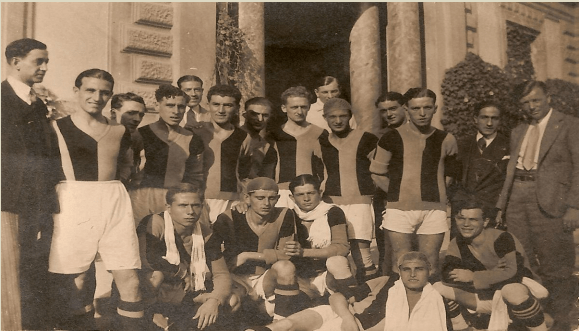
Fig. 7 AS Taranto 1927.
Erasmo of Taranto
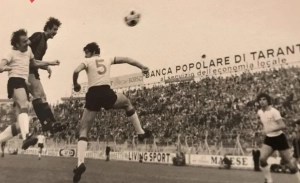
Fig. 8 Erasmo Iacovone scoring from one of his famous headers.
“A good man, exceptional on the field and off the field as a person. As a Centre Forward he knew how to do everything, he was fast, intuitive, he anticipated his adversaries well with his head and his feet”
Roberto Boninsegna (Inter Milan and Italy centre-forward) on Erasmo Iacovone.
By 1977 Taranto had become a regular fixture in Serie B having completed 8 seasons in Italy’s second division. However, the 1977/78 season would prove to be most special and unfortunately most tragic. Taranto would go on to have their most memorable season where a new hope and belief would be installed. The man leading this charge with his famous moustache was a signing from the previous season. It was the number nine Erasmo Iacovone who would go on to be also called “Iacogol”.
Born in 1952, in the town of Capracotta in Molise, Erasmo had developed his passion for Calcio in the streets of his hometown. Erasmo’s brother Giacomo discusses that ” he loved football, he would always arrive home with scuffed clothing and deformed shoes and he would often play six or seven games a day.” Once Erasmo hit his teens, he was soon snapped up into a youth team named Albulla. In 1969, Erasmo at the age of 17 had gained the attention of OMI Roma a team from Frascati which in 1974 became Lupa Roma. In 1972 at the age of 20 he secured a move to the far north of Italy playing for Triestina before moving to Carpi in 1973 and Mantova in 1974 where he scored eleven goals in his first season. These teams all inhabited Serie C and D. Erasmo had gained a high price tag for the Italian lower divisions which was around £166,000 in today’s money. At first, Taranto’s president Giovanni Fico wasn’t convinced to spend all that money on Erasmo. It took Taranto’s assistant coach Tommaso De Pietri, who’d worked with Iacovone at Carpi in 1973/74 to convince Fico and manager Domenico Rosati (humorously nicknamed Tom) to go all out on Iacovone, and in 1976 the payment was made and Erasmo arrived in Taranto and Serie B.

Fig.9 1976 Serie B Stickers Paolo Rossi and Erasmo Iacovone.
In Ersamo’s two seasons in Serie B, he would cross paths on the pitch with many notable names. It is safe to say that Serie B was producing future legends of the Italian game. Paolo Rossi future hero of the the 1982 World Cup was at L.R Vicenza, Marcello Lippi future World Cup winning manager in 2006 was a player at Sampdoria, Cesare Prandelli at Cremonese, Alessandro Altobelli at Brescia and the “Tinkerman” himself Claudio Raneiri was a player at Catanzaro. For the real hardcore fans, Vito Chimenti was also at Catanzaro and future Inter legend Claudio Ambu was at Ascoli. It is also worth mentioning that Erasm’o’s team mate at Taranto Franco Selvaggi, like Rossi, would also go on to be future World Cup winner in 1982.
The 76/77 season overall was a strong season for Taranto’s standards at the time having finished ninth. Ersamo Iacovone had established himself as the top goal scorer at Taranto with 8 goals, a tally he will have aready exceeded at the half way point of the next season. Is it also worth noting that Erasmo did not just score ordinary goals, he appeared to score goals of unique finesse and with a degree of unparalleled athleticism in very important games. Such as the goal scored in the Puglia derby against Bari (Please excuse the terrible music, this the only video I could find). This goal alone would have been enough to establish himself as hero for eternity. As far as the 76/77 season was concerned Taranto had completed a solid season and had built a solid base to build a better team. However, no one would have dared to predict just how good the team would prove to be come the 77/78 season.
Fig. 10 Erasmo Iacovone scoring in the Puglia derby. A goal of absolute class.
Taranto started the 77/78 season in excellent fashion only losing one of their first ten matches to Cremonese, Cesare Prandelli being among the goalscorers. By Christmas of that year, Taranto were only 4 points off the promotion places occupied by Ascoli, U.S Catanzaro, Avellino and Monza. Belief was truly beginning to set in. This was truly an exciting time to be a Taranto fan and stories of how Erasmo Iacovone captured the hearts of all Taranto fans are endless. In a radio interview on Radio Vera the author of Erasmo Iacovone – Il Taranto Piu Bello Davide Vendramin recalled how the stadium stood when Erasmo charged at the opposition and the fans in synchronised fashion began lift their seats pads up to slam them down to a slow beat to make a huge noise throughout the Salinella. The sounds and the electric atmosphere Erasmo created at the stadium is said to have been amazing, and the fans came to adore him even more. Having scored over ten goals in the league and Italian Cup along with fighting Massimo Palanca of Catanzaro for the Capocanoniere prize, Erasmo was attracting the attention of much bigger teams in January. Among these teams were Roma and Fiorentina. Guess what, in true fashion of such a hero, and alla Francesco Totti, he allegedly politely refused their offer and the fans got wind of this and loved him even more.
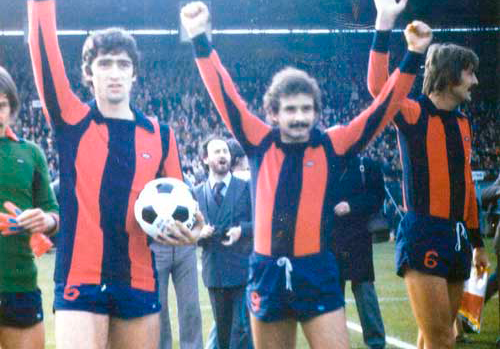
Fig.11 Renzo Castagnini, Erasmo Iacovone and Giorgio Fanti
Taranto appeared destined to secure promotion due to their trajectory up the table. Their results in the Coppa Italia further cemented this notion by securing draws against AC MIlan and Juventus. Realistically thinking, they had every chance of perhaps securing promotion. However, the truth is we will never know how Taranto would have continued throughout the season of that year with Erasmo Iacovone, as things were about to take a very sad and tragic turn. On the 6th of February 1978, Taranto had drawn 1-1 at home to Cremonese. That night Erasmo and his teammates Franco Selvaggi and Graziano Gori went out to a restaurant, after the meal, Erasmo chose to leave early and got into his Citroen Dyane to drive home. Whilst this was happening a man in a stolen Alfa Romeo GT 2000 was charging down the road which leads to San Giorgio Ionico with the lights off. As Erasmo was leaving he entered the road at the junction. The Alfa Romeo GT 2000 smashed in Erasmo’s Citroen Dyane killing him instantly.
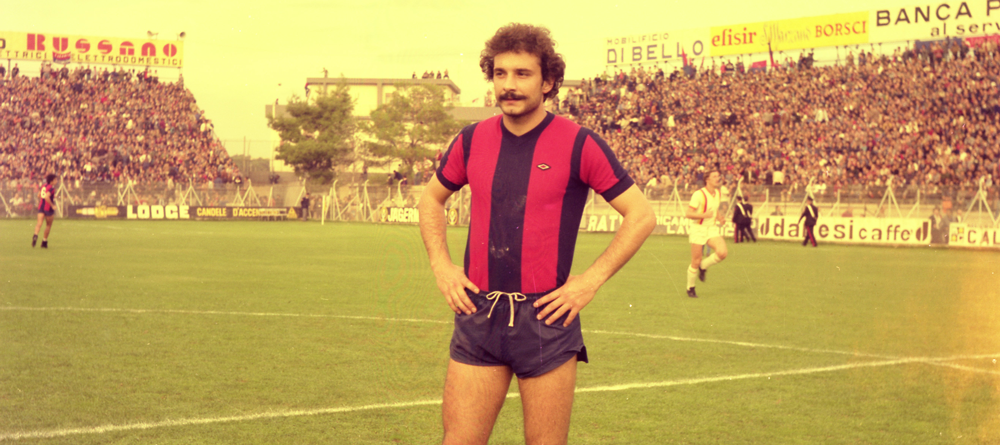
Fig. 12 Erasmo Iacovone
Two days after his death, the president of Taranto Giovanni Fico decided to change the name of the stadium from Lo Stadio Salinella to Lo Stadio Erasmo Iacovone. It also said that 15,000 people attended his funeral in the city. They have described this moment in Taranto’s history as an “interrupted dream”. Taranto after the tragic death of their talisman faced off against Rimini away and won 1-3 in Erasmo’s honour. However, after that, they appeared to drop like a stone down the league table finishing in 11th place that year whilst Ascoli won the title. Taranto would have a few more great moments in their history including beating a star studded Juventus team in 1990 in the Coppa Italia. They would also have other heroic talisman like Christian Rigano who before moving to Fiorentina in 2002 had scored 41 goals in 64 appearances for Taranto. Perhaps a story for another time. However, it can be said, that what Erasmo Iacovone achieved in such a short amount of time at Taranto has never the left the memory of the city, and it remains forever part of the identity of the club and it’s fans.
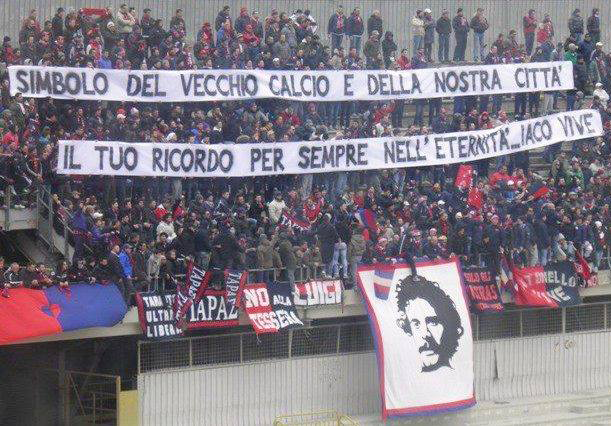
Fig. 13 ” The symbol of old football and our city, your memory is eternal Iaco lives”
Further Reading
John Foot, Calcio, A History of Italian Football, London 2007
George Gissing, By the Ionian Sea, Notes of a Ramble in Southern Italy, CreateSpace Independent Publishing Platform; 1st edition (28 Feb. 2016)
Richard Holt, Sport And The British: A Modern History (Oxford Studies in Social History), Manchester, 1990
M.Morelli, Iacovone, La Vita di Erasmo in un Lampo, Torino 2006
D.Vendramin, Erasmo Iacovone. Il Taranto più bello. Cronistoria della stagione 1977-1978, Taranto 2017
F. Zara, Tragedia a fari spenti, il sogno spezzato del re di Taranto, in «La Gazzetta dello Sport», Milano, 3 febbraio 2022
 Calcio Stories of a Different Kind
Leave a comment